A basement bathroom sounds simple until you get to the part where waste has to move uphill.
That single detail shapes almost every basement bathroom plumbing option. If your basement sits below the main sewer line leaving the house, gravity alone will not do the job. You need a system that handles waste reliably, protects the rest of your plumbing, and fits how you actually use the space. A lightly used half bath has different needs than a full bathroom serving guests, kids, or a finished basement apartment.
How basement bathroom plumbing options really work
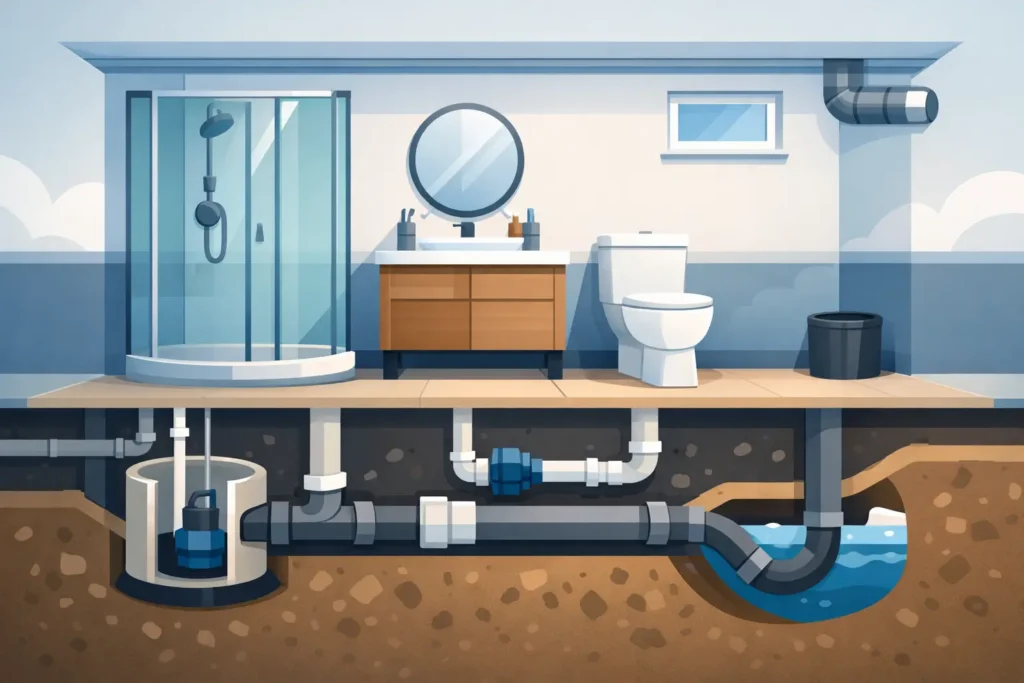
In most main-floor bathrooms, wastewater flows downhill into the home’s drain system. In a basement, that is not always possible. The toilet, sink, and shower may sit lower than the sewer or septic line exiting the foundation, which means waste needs help getting out.
That is why the right choice usually comes down to one of three paths: a traditional below-slab drain connection, an upflush toilet system, or a sewage ejector pump setup. Each can work well, but each comes with trade-offs in cost, performance, noise, maintenance, and how much remodeling is involved.
If you are planning a basement bathroom in an older home, the answer may also depend on what rough-in plumbing already exists. Some basements were built with a future bathroom in mind. Others were not, and that changes the project quite a bit.
Option 1: Traditional below-slab plumbing
This is the most conventional setup and, in many cases, the most solid long-term choice. It involves breaking through the concrete slab, installing proper drain lines below the floor, and tying the bathroom into the home’s drainage system. If the main sewer line is low enough to allow gravity drainage, this approach can work like any other bathroom in the house.
When homeowners want a full basement bathroom with a standard toilet, shower, and sink, this option often gives the most natural performance. Fixtures drain the way people expect. There is no macerating unit behind the toilet and no above-floor pump box taking up space.
The downside is the work involved. Cutting concrete, trenching for pipe, and restoring the floor adds labor and mess. If the sewer line is not low enough, you may still need a pump system even after opening the slab. That is why a camera inspection or site assessment matters before anyone starts demolition.
This route usually makes the most sense when you are already doing a larger basement remodel, when you want the cleanest finished look, or when you plan to use the bathroom often for years to come.
Option 2: Upflush toilet systems
An upflush system is one of the most talked-about basement bathroom plumbing options because it can reduce construction work in a big way. Instead of relying on a standard toilet draining into pipes buried below the slab, an upflush toilet uses a macerating or pumping unit to move waste through smaller discharge piping.
For homeowners who want to avoid tearing up concrete, that can be a real advantage. Installation is often faster, and it can be a practical fit for a basement half bath or a guest bathroom that does not see heavy daily use.
Still, this option is not a shortcut in the bad sense only if it is chosen for the right situation. Upflush systems have moving parts, and moving parts eventually need service. They can also be noisier than standard gravity-flush toilets. Some units can connect to a sink and even a shower, but not every layout works equally well, and fixture placement has to follow the manufacturer’s limits.
If your main goal is adding a bathroom with less disruption, an upflush system may be worth considering. If you want something that feels as close as possible to a conventional bathroom and will get constant use, a more traditional setup may be the better value.
Option 3: Sewage ejector pump systems
A sewage ejector pump is often the best answer when the bathroom will sit below the sewer line and you want to use standard fixtures. In this setup, wastewater flows into a basin, usually set below the basement floor, and the pump sends it up to the home’s main drain line.
This gives you more flexibility than many upflush systems. A full bathroom with a regular toilet, shower, tub, and sink can usually be handled more like a standard plumbing layout. For finished basements, family living areas, and spaces that will get routine use, that matters.
The trade-off is that the system is more involved than a simple above-floor install. The basin and pump must be sized properly, vented correctly, and installed so they can be serviced later. Poor installation can lead to odors, clogs, frequent cycling, or pump failure. This is one of those jobs where cutting corners tends to show up later, often at the worst possible time.
A well-installed ejector system is dependable, but it is still a mechanical system. It should be treated as part of the home’s critical plumbing and checked if you notice unusual noises, slow drainage, or backups.
Which basement bathroom plumbing option is best?
The best choice depends on how you plan to use the bathroom, what your basement already has in place, and how much remodeling you are prepared to do.
If you are finishing a basement for long-term family use, a traditional drain system or sewage ejector setup usually gives the best overall result. If you just need a convenient toilet and sink for guests or a workout room, an upflush system may do the job without turning the basement into a construction zone.
Budget matters, of course, but so does reliability. Homeowners sometimes focus only on the lowest install cost and forget to think about future service, lifespan, and day-to-day comfort. A basement bathroom that clogs easily, runs loudly, or struggles to keep up is not much of an upgrade.
The hidden factors homeowners often miss
Drainage is only part of the decision. Venting, water supply lines, fixture spacing, and access for repairs all matter too. A basement can be tight, especially if you are working around framing, mechanical equipment, or low ceiling areas.
Moisture is another factor. Basements naturally deal with more humidity than upper floors, and adding a shower increases that load. Good plumbing design should work alongside proper ventilation so the new bathroom does not create mold or dampness issues nearby.
Then there is the question of what is already under the floor. Some homes have rough-in stubs for a future toilet, sink, and tub. If that rough-in was installed properly and sits in the right place, it can save time and money. If not, it may still need adjustment. It is better to verify than assume.
Cost versus disruption
There is no one-size-fits-all price for a basement bathroom because the plumbing approach drives the cost. A simpler upflush installation may lower demolition and labor. A below-slab system may cost more up front but provide a more conventional result. A sewage ejector system often lands somewhere in the middle to upper end depending on fixture count and layout.
The better way to look at it is cost versus disruption versus long-term value. Some homeowners want the least invasive path. Others want the most permanent setup and are willing to invest more now. Neither approach is wrong if the system matches the home’s needs.
Why professional planning matters
Basement plumbing mistakes are harder to fix than a leaky faucet or a clogged sink. If drain pitch is wrong, venting is incomplete, or a pump is undersized, the problem may not show up until the bathroom is already finished. By then, repairs are more expensive and far more frustrating.
That is why this kind of project benefits from a clear plan before fixtures are purchased or walls are framed. A plumber should look at the sewer line elevation, the basement layout, expected fixture load, and access for maintenance. Those details decide whether a lower-cost option is smart or whether it will turn into a headache later.
For homeowners in Port Orchard and nearby areas, this is especially true in older homes where basement conditions vary a lot from one property to the next. What worked in your neighbor’s house may not be the best fit in yours.
If you are weighing basement bathroom plumbing options, the right move is usually the one that solves the drainage challenge without creating a service problem down the road. A bathroom should make your home easier to live in, not give you one more thing to worry about. If you are unsure which path makes sense, get the layout checked before the build starts. It is a lot easier to plan for a reliable bathroom than to repair one after the concrete, tile, and drywall are already done.