Hard water often announces itself in small, frustrating ways: white crust around faucets, cloudy glassware, stiff laundry, and a water heater that seems to work harder than it should. When homeowners compare a water softener versus conditioner, the question is usually simple: Which one will actually solve the problem without creating a new maintenance headache?
The right answer depends on what is in your water, what you want to change, and how much ongoing care you are comfortable taking on. A softener and a conditioner are not interchangeable names for the same equipment. They work differently, produce different results, and make sense for different households.
What Hard Water Does Around the House
Hard water contains dissolved minerals, mainly calcium and magnesium. Those minerals are not usually a health concern, but they can be tough on plumbing fixtures, appliances, and cleaning routines.
As water heats up or evaporates, minerals can be left behind as scale. You may see it on shower doors and faucet aerators, but it also collects where you cannot easily see it: inside water heater components, supply lines, dishwashers, and washing machines. Over time, buildup can affect performance and shorten the service life of equipment.
Soap also reacts differently in hard water. Instead of rinsing cleanly, it can leave behind a film on skin, dishes, tubs, and clothing. That is why some homes use more detergent and still struggle with spots or dull-looking laundry.
Before choosing equipment, it helps to confirm whether hardness is truly the issue. A water test can identify mineral levels and may reveal other water-quality concerns that call for a different solution. Buying a system based only on a few spots on a glass can lead to disappointment.
How a Water Softener Works
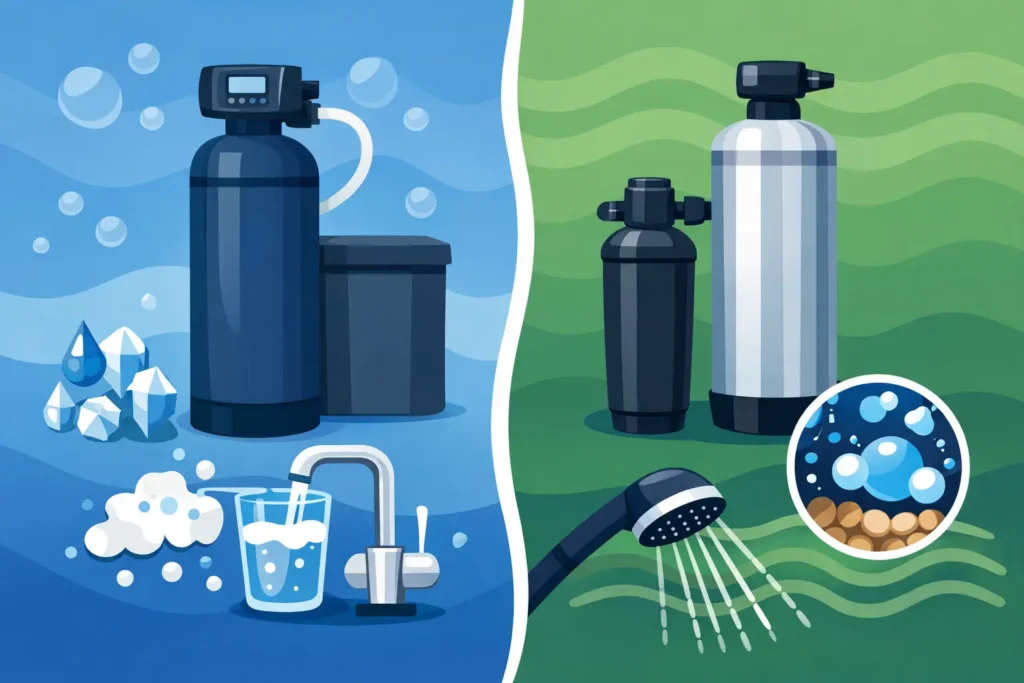
A conventional water softener removes hardness minerals through a process called ion exchange. Inside the system is a tank filled with resin beads. As water passes through, calcium and magnesium are exchanged for sodium or potassium ions.
The result is genuinely softened water. Soap lathers more easily, dishes typically rinse cleaner, laundry may feel softer, and scale buildup is greatly reduced. For homeowners dealing with significant mineral deposits or repeated appliance scale, this is often the most noticeable solution.
The trade-off is maintenance. Most softeners use salt pellets, which replenish the system during regeneration cycles. The homeowner needs to keep the brine tank supplied, and the unit needs proper settings so it regenerates efficiently based on household water use and hardness level.
A softener also uses water during regeneration. That does not make it a poor choice, but it is part of the ownership cost. Households on water-sensitive systems, those trying to reduce salt use, or anyone who does not want to haul bags of salt should weigh that routine carefully.
What You Can Expect From a Softener
With a properly sized and installed softener, the changes are usually easy to notice. Fixtures stay cleaner longer, shower glass may need less scrubbing, and hard scale inside appliances becomes less of a concern. Existing buildup will not disappear overnight, though. It may take time and cleaning to remove deposits that formed before the softener was installed.
Soft water can also feel different in the shower. Some people like the smoother feel, while others need a little time to adjust because soap rinses differently. That is normal and not a sign that the water is unsafe or that soap is still on your skin.
How a Water Conditioner Works
The word “conditioner” can mean different things, which is one reason this decision gets confusing. In many cases, a water conditioner is a salt-free system designed to change how hardness minerals behave rather than remove them from the water.
Some conditioners use a media that encourages minerals to form tiny crystals. The minerals remain in the water, but they may be less likely to attach to pipes, heating elements, and fixtures as hard scale. Other products use different approaches, and their results can vary widely by technology, water chemistry, and installation quality.
A conditioner does not create soft water in the same way a traditional softener does. It generally will not eliminate hard-water spotting, make soap lather like it does in soft water, or reduce the mineral reading on a hardness test. That distinction matters. If your main goal is softer laundry and fewer spots on every dish, a conditioner may not meet your expectations.
Still, a conditioner can be a practical option for homeowners who are mostly focused on scale control, prefer not to add salt, or want lower routine maintenance. Many systems do not require electricity, a drain connection, or regular bags of salt. Replacement media or cartridges may still be needed, so “maintenance-free” should always be read closely.
Water Softener Versus Conditioner: The Real Differences
A water softener removes calcium and magnesium. A conditioner generally leaves those minerals in the water and aims to reduce the way they build up on surfaces and inside plumbing. That is the central difference.
Choose a softener when you want the full soft-water experience and your water test shows moderate to high hardness. It is often the stronger choice for homes with stubborn scale, frequent spotting, poor soap performance, or water-heating equipment that has been affected by mineral buildup.
Choose a conditioner when salt avoidance, lower water use, or less hands-on upkeep is a priority and your main concern is reducing scale. It may also make sense when the home’s hardness level is lower or when a homeowner wants an added layer of scale protection without changing the feel of the water.
Cost should be evaluated over time, not just by the price of the unit. A softener may cost more to operate because of salt, water use, and periodic service. A conditioner may have fewer routine costs, but replacement media and the possibility of less dramatic results should be part of the decision.
Sizing and Installation Matter More Than Most People Expect
Even the right type of equipment can perform poorly when it is undersized, oversized, or installed in the wrong location. A system should be selected based on hardness level, household size, water use, plumbing layout, and the equipment it will protect.
For example, a busy family with multiple bathrooms and frequent laundry loads needs a system that can handle peak demand. A unit that is too small may regenerate too often or fail to keep up. One that is too large can waste resources or add unnecessary cost.
Installation also needs to account for shutoff access, drainage where required, bypass valves, and proper connections to the home’s main water supply. Poor workmanship can turn a water-treatment upgrade into a leak risk or a maintenance problem. That is especially frustrating when the goal was to protect the plumbing in the first place.
In Port Orchard and across Kitsap County, water conditions can vary from one property to another. A neighbor’s equipment may be a useful reference, but it is not a substitute for testing your own water and reviewing your home’s needs.
Questions to Ask Before You Buy
Start with the problem you want to solve. Are you tired of cleaning scale from fixtures? Are clothes rough and dishes spotted? Is your water heater showing signs of mineral buildup? Or are you trying to avoid salt and reduce maintenance?
Then ask what the system is proven to do. A clear answer should explain whether it removes hardness minerals or only changes their scale-forming behavior. Be cautious of broad promises that a conditioner will deliver every benefit of a traditional softener without any trade-offs.
Also ask about ongoing costs, warranty coverage, maintenance intervals, and what happens if the system needs service. A good installation should leave you knowing how to use the bypass, when to add salt or replace media, and who to call if something does not seem right.
If you are unsure which route fits your home, a qualified plumber can review your water test, current plumbing, and goals without burying you in technical jargon. Leakless Plumbing focuses on practical solutions that help prevent repeat problems, not quick fixes that leave you guessing.
The best system is the one that matches your water and your household routine. Start with a water test, set realistic expectations, and choose equipment that protects your plumbing while making daily life a little easier.